

Mathematics Navigator: A Safety Net Program for Struggling Students
Angela Phillips and Rick Pinchot
Angela Phillips and Rick Pinchot
Rick Pinchot and I presented a session on our school's success in using Mathematics Navigator, a mathematics safety net program developed by America's Choice for helping students who have fallen approximately two years behind that of their peers in core math content areas (such as fractions, place value, and conceptual understanding of operations). 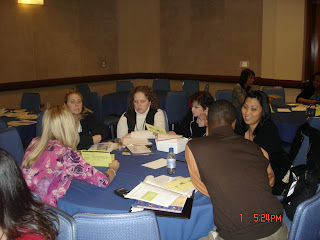
We began our presentation by sharing the Chets Creek Data Story. We shared the Vision of our school and our history of "high-stakes" results on FCAT Mathematics (grades 3-5), our state's "high stakes" accountability test. Our data shows a steady increase from year to year from where we began with 21% of our students scoring at proficiency levels (10 years ago when our school first opened) to where we are now- with over 90% of our students meeting proficiency in recent years. In considering N.C.L.B., the effort to leave NO child behind, our emphasis two years ago became searching out a meaningful and aligned safety net program (to compliment our everyday regular classroom "constructivist and conceptual-based teaching", which occurs in all classrooms Kindergarten through Fifth Grade in our school.
We shared our excitement in finding Math Navigator, and remarked on the six "philosophies" of Navigator to help tell our success story. From there, we introduced our participants to the components of Navigator- the "Skill Cards" and a "Lesson". After our participants had the opportunity to work through several skill cards and a Navigator lesson, we regrouped to discuss anticipated student misconceptions that would arise and be addressed (corrected) through the lesson. We then shared actual samples of student work from the lesson and discussed the student misconceptions that were evidenced in the work. We then shared what each of the four students learned from their mistakes when they corrected their work after receiving teacher feedback and further development.
 The next emphasis of our presentation was to share the various Implementation Models that we have found successful for use in our school (through our Extended Day after school program, through our Exceptional Student Education department, and through committed teachers and coaches pulling small groups of students before and after school).
The final and most important component of our presentation was to share our incredible results. Our "Data Story" shows that over 98% of the students in our school (these modules serve grades 2-5) who have gone through a complete Navigator safety net module have shown improvement, and in many cases, the improvement has been significant. Almost all of the students who are assessed on FCAT (grades 3-5), scored at proficiency levels on the assessment after participating in a Navigator module of study. Our previous predictions of these students indicated that they would not have scored at proficiency levels had they not experienced Math Navigator. Our sources in making these earlier predictions, which helped to identify these students as needing to be targeted for participating in this program, came from a very reliable diagnostic resource- a comprehensive math diagnostic assessment used in our school and developed by teachers in our school to document growth (August to December to May) and predict performance on FCAT based on our alignment of historical data (December midyear scores) to what students actually received on FCAT (taken in March) in years past. The results we have received from implementing Math Navigator with our struggling math students far outweighs any mathematics safety net attempts we had explored prior to using this product.
 For these reasons, we highly recommend this safety net program to any elementary school searching for a conceptually based safety net mathematics program. Math Navigator identifies and surfaces student misconceptions in the context of the embedded assessments (pre-, checkpoint, and post-); addresses concept, skill and problem solving development; teaches students to be held accountable and responsible for their own learning; and best of all, improves teacher pedagogy, which then transfers into the regular classroom and affects all learners in the teachers' care.

We began our presentation by sharing the Chets Creek Data Story. We shared the Vision of our school and our history of "high-stakes" results on FCAT Mathematics (grades 3-5), our state's "high stakes" accountability test. Our data shows a steady increase from year to year from where we began with 21% of our students scoring at proficiency levels (10 years ago when our school first opened) to where we are now- with over 90% of our students meeting proficiency in recent years. In considering N.C.L.B., the effort to leave NO child behind, our emphasis two years ago became searching out a meaningful and aligned safety net program (to compliment our everyday regular classroom "constructivist and conceptual-based teaching", which occurs in all classrooms Kindergarten through Fifth Grade in our school.
We shared our excitement in finding Math Navigator, and remarked on the six "philosophies" of Navigator to help tell our success story. From there, we introduced our participants to the components of Navigator- the "Skill Cards" and a "Lesson". After our participants had the opportunity to work through several skill cards and a Navigator lesson, we regrouped to discuss anticipated student misconceptions that would arise and be addressed (corrected) through the lesson. We then shared actual samples of student work from the lesson and discussed the student misconceptions that were evidenced in the work. We then shared what each of the four students learned from their mistakes when they corrected their work after receiving teacher feedback and further development.
 The next emphasis of our presentation was to share the various Implementation Models that we have found successful for use in our school (through our Extended Day after school program, through our Exceptional Student Education department, and through committed teachers and coaches pulling small groups of students before and after school).
The final and most important component of our presentation was to share our incredible results. Our "Data Story" shows that over 98% of the students in our school (these modules serve grades 2-5) who have gone through a complete Navigator safety net module have shown improvement, and in many cases, the improvement has been significant. Almost all of the students who are assessed on FCAT (grades 3-5), scored at proficiency levels on the assessment after participating in a Navigator module of study. Our previous predictions of these students indicated that they would not have scored at proficiency levels had they not experienced Math Navigator. Our sources in making these earlier predictions, which helped to identify these students as needing to be targeted for participating in this program, came from a very reliable diagnostic resource- a comprehensive math diagnostic assessment used in our school and developed by teachers in our school to document growth (August to December to May) and predict performance on FCAT based on our alignment of historical data (December midyear scores) to what students actually received on FCAT (taken in March) in years past. The results we have received from implementing Math Navigator with our struggling math students far outweighs any mathematics safety net attempts we had explored prior to using this product.
 For these reasons, we highly recommend this safety net program to any elementary school searching for a conceptually based safety net mathematics program. Math Navigator identifies and surfaces student misconceptions in the context of the embedded assessments (pre-, checkpoint, and post-); addresses concept, skill and problem solving development; teaches students to be held accountable and responsible for their own learning; and best of all, improves teacher pedagogy, which then transfers into the regular classroom and affects all learners in the teachers' care.
Click below to watch the video of our presentation:


