Saturday, May 9, 2009

Featured Authors: Betsy Franco and Debra Fraiser

Refresh your math, science and creative writing ideas with tips from author Betsy Franco (her biography).
I loved how Betsy introduced herself and her family. Her family are all featured artists and very much involved with her works. For example in her first young adult novel, METAMORPHOSIS, from Candlewick Press in October 2009, her sculptor son Tom is the illustrator, and her actor sons, James and Dave, read the audio version!

She was animated and excited about her works for children. Her mission today was to share her books as a support tool for the subjects of math and science. Once she modeled the creation of her books she shared the works of children by displaying what the children created using her style with other topics of math, poetry, and science. I found this great interview posted by Paticia Newman and I think you will understand this author/illustrator a little bit better after reading it.
Interview with Betsy Franco

Betsy's Website


Debra Fraiser presented Books in the Classroom-What Happens After Reading?
She shared how schools across the United States of America have extended her books with individual projects or full school events.
Her site is rich with resources and ALA awarded this website a place on their GREAT SITES FOR KIDS list!
The Miss Alaineus Vocabulary Parades were outstanding and get this she is offering to all of us to enter her contest. If we do and create our own Miss Alaineus Vocabulary Parade, she will come down and give us a free author visit. You know I am all over this challenge. Check out her site and see just how amazing the other schools performed.

2010 = 10th Anniversary of Miss Alaineus, A Vocabulary Disaster!
Celebrate with your students in two ways:
Bring Debra Frasier to your classroom through the ongoing video shorts series: Small Answers to Big Questions about Picture Books
Enter the Vocabulary Parade Contest!
Grand Prize: A FREE Debra Frasier Author Visit!
Lots of other prizes, too!
Official rules posted Sept 1, 2009. Categories will include Most Original Use of a Word, Funniest, Ten Best, and the Grand Prize: ten excellent costumes, participation numbers, and teacher & principal costumes from a single school.
Plan to enter? September 1 - 30 all interested schools can download the 30 page Vocabulary Parade Planning Kit for free! See you here on Sept 1, 2009.
I enjoyed her so much and here is a special message from Debra.

Wednesday, May 6, 2009

Storytellers-Developing and Using Tandem Stories and Reader's Theatre

Presented by:
Betty Roe, Tennessee Technological University, Cookeville, TN
Michael Roe, Mikro Enterprises, Crossville, TN
This session demonstrated tandem stories and discussed the differences in required preparation between telling tandem stories and telling individual stories. They described the language instructional benefits of using tandem stories and explained how they turned literature selections into tandem stories.
I wanted to understand the tandem storyteller so I attended to find out more. I attempted to look up the word tandem, one of Wikipedia's definitions stated this: "Tandem" can be used more vaguely to refer to any group of persons or objects working together, not necessarily in line.[2] "In tandem", for example, in politics and business to describe joint plans and ventures. A tandem may also refer to Tandem language learning, a language learning method in which two partners of different mother tongues each help the other learn the foreign language.


Mike and Betty opened with this particular style of storytelling and explained how this strategy helps with language skills.

The story they shared was the "Magic Pot". Together, side by side they began. They opened speaking in unison, then they separately spoke a line or two, then they return back to a unison speaking part. It looks easy, but as a storyteller I can tell you it is truly difficult.


Timing, timing, timing.
Props aren't used. Michael and Betty changed the story to better fit their style and to make it better as a tandem story. I learned real quick it is better to have short sentences.

Tips on Telling a Tandem Story
  • Tell, don't recite word-for-word

  • Except for unison parts

  • Listen for cues from your partner

  • Practice to get your timing and cues right

  • Internalize the story, so a dropped line won't cause a problem.

  • Narrator: Face audience- allows eye-contact

What are the benefits of tandem telling?

Language Skills Development


  • Reading or listening to stories

  • Analyzing-vocabulary, sequence, cause and effect, characterization, action, story structure

  • Writing to combine versions or divide into parts

  • Repeated reading to learn stories

Speaking Skills

  • volume

  • pitch

  • enunciation

  • pronunciation

  • pacing register

  • vocabulary

Listening Skills

  • Audience- vocabulary and story structure

  • Participants- cues for speaking

Reader's Theatre

  • Interpretive oral reading experience

  • dramatic

  • script is right in front of you

  • no sets, costumes or props needed

Benefits of Reader's Theatre

  • many of the same benefits as tandem telling
  • reading fluency
  • reading vocabulary

  • reading comprehension

  • can be numerous readers

Benefits especially important for ELLs and struggling and reluctant readers


  • expands vocabulary

  • involves them in collaboration with peers

  • boosts self esteem

  • improves attitude

Materials for Reader's Theatre


  • play scripts
  • poems

  • stories with dialogue

  • selections from content area texts

  • nonfiction trade books

  • materials with few scenes and characters

Student Preparation

  • teacher modeling

  • discussion

  • development of assessment rubric or questions

Script Preparation

  • narrator and characters
  • large print

  • highlighting for emphasis

  • purposeful focus on story elements

Sources: free scripts and stories

http://www.aaronshep.com/

www.aaronshep.com/rt/index.html

Cast Parts

  • consider reading levels

  • allow group decisions in some cases

  • consider rotating parts for repeated performances

  • have teacher as narrator in lower level classes

Rehearsal Time

  • move from group to group

  • give suggestions

  • ask pertinent questions

  • offer encouragement

  • students sit or stand before the performance
Let's experiment with this new type of storytelling and use it to encourage the student that dreads the writing assignment. Can't wait to get back and try it at Chets!

Betty D. Roe broe@tntech.edu

Michael H. Roe mikeroe.xvl@gmail.com


The "Art of Conversation" Using the Arts to Promote Authentic Response to Literature in Struggling Readers

Presented by:
Neva V. Cramer, Ph.D.
Schreiner University
nvcramer@schreiner.com

Angelle Stringer, Ph.D.
Louisiana Resource Center for Educators
angelles@lrce.org


Wow…that is all I can say is “wow”.


Angelle identified herself as a 13 year old trapped in an adult body. Her passion is working with struggling students. Her mission is to reach the students that fall behind, you know the ones, the reluctant ones, the ones who are trying not to be the “dumb” ones so they become the “bad” ones. These two women started off with a bang and never let up for 2 hrs. and 45 min. They empowered each one of us with strategies enabling our students to connect with themselves, each other and the outside world.


Sidenote: The whole time that Neva spoke, I thought to myself, “I know this person”. I just couldn’t put my finger on it. She has a star-like quality and I later found out that she has appeared and starred in movies. No wonder she wants to use the arts.

After experiencing the hands-on workshop they prepared for all attendees, I was convinced the arts can motivate reluctant readers and you don’t have to be the art teacher to achieve the goal of promoting the love of literature.
Objective: Making the reluctant readers' thinking visible.

The encouragement of capturing the inner conversation of the artist's creation really makes one think about restructuring the way we each present literature.
Think of the composer…it is in his/her head first…we have to help the reluctant students to transfer it to others using paper, conversation or through illustration.

One of our activities involved one of my favorite books: "Tuesday" by David Weisner
She showed this wordless book through the tool of a laptop using the software of power point where she had previously scanned the pictures. She then asked us to use the tool of the story pyramid and to break into small groups to fill in the blanks.


Story Pyramid
1. Main Character-
2. Describe Character-
3. Setting-
4. Problem-
5. 1st event-
6. 2nd event
7. Solution/Resolution
Each group had conversation about the book. This is an amazing example of "pictures telling a story". There is no right or wrong answer, soooooooo, try it in your own classroom and watch your reluctant readers soar.
They referenced Project Zero project at Harvard as just one example to support their work.
Project Zero's mission is to understand and enhance learning, thinking, and creativity in the arts, as well as humanistic and scientific disciplines, at the individual and institutional levels. Take a look at the site it will provide some clarity about this initiative.


Some of the books they shared in this total interactive workshop were:
The Outsiders

Just Like Josh Gibson


Grandfather's Journey

They also shared music and proved using all of us as the guinea pigs the results of leaving reluctant readers wanting to know more. They shared Don McLean's "Vincent" making all of us want to research about the life of Vincent Van Gogh.

I can't wait to share all of the handouts and ideas they shared. Where's my scanner?

It’s time to put the arts back into the literature!

Tuesday, May 5, 2009

International Reading Association - Minneapolis, MN

54th Annual Convention North Central: Minneapolis, Minnesota
May 3 - 7, 2009, Minneapolis Convention Center

Finally here!
With great expectations I bounced out of bed to attend my first IRA Convention. It has been on my list of things to do for quite some time and I am finally here. I feel like I have stepped into the shoes of Mary Tyler Moore happy, excited, spinning around throwing up my hat in celebration, in fact we passed Mary's
statue on the corner in downtown Minneapolis, Minnesota as we were driving to our hotel.


IRA's 54th Annual Convention North Central opened Monday with the Opening General Session, featuring keynote speaker Khaled Hosseini, bestselling author of The Kite Runner and A Thousand Splendid Suns. I had read both books and couldn’t wait to listen to someone who had pulled on my heart and took my breath in the first chapter. Khaled shared with all of us his journey and how he always knew he was hard wired to be an author.
As a boy he dreamed of being Clint Eastwood, however his life’s path took him in a different way. His father was a diplomat and his mother was a vice principal of a girl’s school. They left their comfortable life behind. They were forced by war to come to this country. Hosseini shared his personal thoughts about what went wrong in Afghanistan and the huge challenges the country is facing. He talked about visiting Afghanistan and getting involved with UNHCR and his development of his own foundation, Hosseini Foundation. His last quote summed everything up as a keynote speaker. He said,” teachers can help the young break the shackles of apathy. It begins in the homes and in the schools.” Not only his books moved me, but his speaking stirred me to care about the lives of others.


Monday, May 4, 2009

Minnesota Here We Come!

Earlier this school year, my Media Specialist and I were contacted by children's book author Pamela Duncan Edwards and illustrator Henry Cole about presenting a session with them at the International Reading Association Conference this year. They have visited Chets Creek a couple of times and love the Book of the Month work that we do as much as we love them! Our proposal was accepted and we will be presenting a symposium this Thursday afternoon at the 2009 IRA Conference in Minneapolis, Minnesota. As always, we will be blogging the conference "live" on the Live From The Creek blog and can't wait to bring back all the incredible things we learn about Reading while attending the conference. Be sure to check in on our adventures as we head to the mid west!

Friday, April 24, 2009

Creating a Brain-Friendly Math Classroom

Creating a Brain-Friendly Math Classroom
Presenters: Sally Kingsley and Connie Conroy, Howard County

This session went into the latest research and information from the book How the Brain Learns Math by David Sousa. (Because of copyright laws, only highlights of the session will be posted.)

The short term memory is divided into two sections, the immediate memory (about 30 seconds) and the working memory (which also has time limits). When things are put in your working memory, they are ready to be transferred to your long-term memory. Research shows that they are best transferred by rehearsal, a "less is more" approach, and through shorter periods. More information about this can be found in Sousa’s book.


Also in Sousa’s book, you will find great information on the stages of brain development, number knowledge at different age ranges, and the best times to learn math content. This book sounded like a great resource to have. I plan on ordering it when I get back home.


Has anyone read this text?

NCTM: Think! Communicate! Justify!

Think! Communicate! Justify!
Presenter: Mickey Jo Sobierajski, Fulton County Schools

This session focused on ideas and activities to empower primary students to become confident problem solvers, good questioners, and critical thinkers.

Ms. Sobierajski opened her session with the following clip:


One of the most important things we need to do is to teach our children how to think. For example, in the clip, the operator did not just answer the little girl’s question, but asked her how much she thought it was. He was attempting to get her to think about it.

The session gave several different calculator game examples for primary students to build critical thinking skills. The games begin easy and build on each other. There is a strategy to each game and each strategy is a little different. In each game, students work in pairs to get the final sum on their calculators. A final sum is given to students as well as a set of rules for each game. Students must take turns until one student reaches the final sum and wins the game.
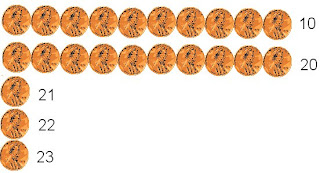
1. Target Number: 7. Students must start with a 0. They can take turns adding only a 1 or a 2 to reach the target number. (Sample strategy: You would want to get a four so that the next time it is your turn, you can win the game by adding a 1 or a 2.)
2. Target Number 10. Students must start with a 0. They take turns adding 1, 2, or 3 to the number to reach the target number.
3. Target Number: 21. Students must start with a 0. They take turns adding 1, 2, 3, or 4 to the number to reach the target number.
4. This is the hardest because it has special conditions and students will have to really think about each number before entering it. Target Number: 25. Students must start with 0. They take turns adding 1, 2, 3, 4, or 5 to the number only if that number or the sum of its digits is not on the screen. (For example, I put in 5. My partner may not add 5 because it is on the screen, so instead she adds 4. I add 3. Now we are on 12. My partner may not add a 1 or 2 because they are on the screen. She may also not add a 3 because the sum of the digits are 3. My partner may only add a 4 or a 5.

To become good problem solvers, students need time to struggle with the problem for teachers to see what they are thinking. Here is a sample problem:
Lauren has 84 identical cubes, each with 2 cm edges. She glues them together to form a rectangular prism. The perimeter of the base is 28 cm. Find the height of the rectangular prism in cm.
What do you know by reading the problem? What do you have to find out? To understand the math, you need to be able to talk the math.
A good problem for students to solve involves interrelated concepts and is at a high level.


Question: When there are 52 green doors, how many blocks will I need all together? Allow students the use of manipulatives to model problems like this if they would like to use them. (Some students will create a number string to solve instead.) If you give students manipulatives, give K students too many and give 2nd grade students not enough to allow them to think critically about it.

Make sure not to use key words when working with a story problem. In all does not always mean to add. If you teach students to look for key words, you are teaching them not to be critical thinkers, but rather to read only the parts of the problem that you need, then solve.
For example: Brian rode 12 rides at the carnival. In all, he spent $9 for rides and $3.50 on snacks. How much did each ride cost? What is this problem really asking us?

Beware of the vocabulary you use. Are you using vocabulary that may cause a misconception? Do you tell students “I’ll be there in a second” and take longer than a second? This does not help them develop an accurate understanding of one second.

Word Walls can also be used to promote critical thinking in the math classroom. For example, use circles to help sort rules.
Which word does not belong and why? (There could be more than one answer.)
Choose a number that has something in common with the empty circle. (Allow students to figure out what the numbers have in common.)

Another way to promote critical thinking is to give students a scenario and a solution and have them determine the question to be asked.

For example: There are 2 fish tanks in my room. One has 8 guppies and 11 goldfish. The other has 24 fish with an equal number of guppies and goldfish. What question could I ask that would give me a solution of 43? Of 12? Of 23?


Thursday, April 23, 2009

Engaging Students in Significant Math

Presented by Henry Kepner, President of NCTM

In his presentation, Mr. Kepner gave an update of the Council’s promotion of mathematics teaching through its focus on curriculum, the dissemination of teachers’ and researchers’ reflective professional experiences, professional development, and the creation of community and policy support for change.  He reinforced the overall theme of this year’s conference: “Equity: All Means All”. In addition to sharing how NCTM is working to promote equity for all students, he was also careful to include not only minority and impoverished students, but also gifted learners. One compelling statistic that he shared, in which I was unaware of, is that 20% of students who “drop out” of school have been labeled as gifted at some point in their schooling. “All Means All” certainly reflects both ends of the learning spectrum as this point proves.

Mr. Kepner emphasized that the NCTM Curriculum Principles guide teachers in the important mathematical ideas that NCTM recommends be taught at the varying grade levels. In addition, the focal points also guide teachers on when closure of big ideas are expected for particular ideas and concepts. What a vital resource in guiding our educational systems throughout the country.  These principles also emphasize the need for simultaneous preparation for algebra, and the development of conceptual understanding, fluency, and problem solving skills.

Mr. Kepner announced an upcoming resource (book series) known as Essential Understandings, currently being developed by NCTM, which will serve as helpful professional development tools for teachers. This should be a fantastic resource.

In addition, NCTM Topic Books, which will be available Fall 2009, will provide details and examples to support teachers in how to teach the NCTM Focal Points.

Another valuable resource for educators that Mr. Kepner shared during his presentation is a link called “Briefs and Clips” which can be accessed at the NCTM website: www.nctm.org. This link provides educators with quick access to useful and practical research. One topic example is “Effective Homework Assignments”.  There are also many other topics for educators to explore and this resource will continue to grow and develop over time.


NCTM:Children’s Difficulty with Elapsed Time and Giving Change

Reasoning at Two Hierarchical Levels Simultaneously:
Children’s Difficulty with Elapsed Time and Giving Change
Presenter: Constance Kamii from University of Alabama

I decided to go to this session because the title caught my eye. Two of the things that I find some of my students struggle with a lot are elapsed time and giving change, so I headed to this session to learn a few strategies to help me teach these concepts.

Elapsed Time
The presentation opened with Ms. Kamii, a very entertaining presenter, explaining the difference in operational time versus intuitive time. (Most of her data came from a study done by Piaget.) She shared a scenario of a four year old student who was asked several questions about time.

Question: Are you older than your sister?
Answer: Yes because I am taller than her.
Question: Is your grandma older than your mom?
Answer: I don’t think so.
Question: When you are 10, will you be older or your sister?
Answer: I don’t know.

This four year old has a concept of intuitive time. Intuitive is based only on the observable things. She can see that she is taller than her sister, so she must be older than her. She is not able to know if she will still be older than her sister when she is 10 because she cannot see who is taller then. These things are all things that she has deduced as logical based on what she knows. She will eventually move into operational time which is based on temporal reasoning. This is a much higher level of thinking.

Piaget states that there are three types of knowledge:
1. Physical knowledge: objects in the external world (That is a cube. It is red.)
2. Logico-Mathematical Knowledge: Consists of mental relationships with the ultimate source being in your head not knowable with your eyes. Time is not something that is observable, but a series of mental relationships. This is why it requires an operational time in order to understand.
3. Social-Conventional knowledge: knowledge of things like the English language, that Christmas occurs each year on December 25, knowing when it is appropriate to say “please” and “thank you.”

Ms. Kamii stated that there is no way to really show elapsed time to children because it is something that they have to see mentally. A majority of students do not recognize operational time developmentally until third grade.

As teachers work through problems with elapsed time, they should allow students to create and build upon their own understanding in order to build their operational knowledge. Textbooks teach students “standard” ways of determining elapsed time such as counting the hours first, then the minutes, creating a sort of algorithm and subtracting, or counting only the minutes. These strategies do not allow students to construct their own understanding of elapsed time naturally, thus creating misconceptions as they go.

Students should learn elapsed time in a natural progression. How would most of your students solve this problem? Work it in as part of your Calendar Math in the morning and see what the most common answer is.

“I started reading at 8:15 and finished at 9:10. How long did I read for?”
Many second graders in Ms. Kamii’s study said 9 hours – 8 hours is one hour and 15 minutes + 10 minutes is 25 minutes, so the answer is 1 hour and 25 minutes. They do not think logically about the time and realize that their answer cannot possibly be correct because from 8:15 to 9:10 is less than one hour. They are reasoning sequentially.

One way students begin to construct knowledge is to think about the problems in ways that make sense to them. Take this problem for example: I arrived at a birthday party at 6:40. I left the party at 9:15. How long did I stay at the party? One way of making sense of the problem is to think about the 6:40 in terms of how long it will be until we reach the next hour, 7:00. See the thought representation below. Hours are represented across the top, minutes along the bottom.

To help students with elapsed time, we should:
1. Allow students to create their own understanding of elapsed time and ways to model it.
2. Give students meaningful opportunities to work with elapsed time in class. Children are not taught to think about time throughout the school day in a context that is beneficial to them creating their own understanding of it. As teachers, we tend to say “It’s time for lunch, get your things ready” or “at 9:15, you need to be ready to do Calendar Math.” Instead, we should say to our students “How much time do we have until lunch? Are we able to complete a 1 hour and 15 minute math workshop before lunch or would it be best to do a 45 minute science lesson right now?”

Making Change
The second part of the session opened with a quick video clip of a second grader playing store with her teacher. The teacher had a box of candies for 2 cents and a box of lollipops for 3 cents. The student had one dime and one penny in her money box. The teacher began with simple problems. She bought one candy for 2 cents and gave the little girl 2 pennies. The little was satisfied with it and waited for the next problem.
The teacher bought a lollipop for three cents, but gave the little girl four pennies. The little girl gave the teacher back one penny.
The teacher bought 2 lollipops and gave the little girl a dime. The little girl gave the teacher back the entire dime saying that it only cost 6 cents. When asked how much a dime was worth, the little girl said “ten cents.” She knew the value of the dime, but even with prompting from the teacher could not figure out how to use the pennies she had collected from previous transactions in her money box to make change for the dime.
To correctly solve this problem, it requires her to think about several things simultaneously: a dime is worth ten cents, subtracting 10 cents – 6 cents to make change for a dime, and giving the correct change back to her teacher.

Another similar situation, counting change by groups of tens and ones, also causes students to think about more than one concept simultaneously. Students may count this as:
As teachers, we know to transfer the counting from groups of tens to ones when we count it. We are able to think of both concepts simultaneously as we are solving the problem.

How can we correct this in our students? By using the same concepts as working on elapsed time.
1. Allow students to create their own understanding
2. Use meaningful examples.

NCTM: Divide and Conquer: Making Sense of Long Division

Presentation by Dr. Juli Dixon, 
University of Central Florida

Well, this session was just what I needed. For two years, I have had discussion after discussion with fellow mentors and colleagues on how to conceptually teach the long division algorithm and, today, I got the answers that we have been looking for! I will offer an overview of what I learned here,  but I really can not wait to get back to school to engage in some collegial conversation over what I learned today with fellow math geeks Rick, Suzanne, Tom,  Patti,  Sherrie, Tammi, Bridget,  Heather, Katie, and Bobbi! It’s sure to be a lively conversation. Are you ready for some enlightenment? Well, here it is! 

I learned why it has been so difficult for us to try to bridge our students’ understanding from the partial quotients method (or Russian Peasant as we like to call it J), to the procedural method of long division and now it all makes perfect sense. 

After reviewing the differences between measurement and sharing/partitive types of division problems, Dr. Dixon taught us that we need to represent long division with a SHARING (not MEASUREMENT) approach. (This means that there is not a natural or easy transition from Russian Peasant Division to Long Division.) Instead, the use of base ten blocks (hundreds, tens, ones) and/or quick draws of base ten blocks, along with “sharing language”, needs to be reinforced.  

SHARING/PARTITIVE APPROACH:

As an example, for the problem 536 divided by 4, you would need 5 hundreds flats, 3 tens rods, and 6 cubes.  Starting with hundreds, you would equally share “1” hundred flat among four piles (notice the recording method in the example shown below). The one “left over” would then be decomposed into ten tens rods to make 13. Sharing the 13 tens rods equally in the 4 groups would put 3 in each group with one left over, which would again be decomposed (exchanged) into 10 cubes for a total of 16. The 16 cubes shared equally into the four piles would place 4 in each pile with none left over. 

The end result would show 4 EQUAL PILES OF 134.

                    134

            4  )  536

                   -4          (hundreds)

                    13        (tens)

                  -12        (tens)

                    16       (ones)

                  -16       (ones)

                    0


Once students make sense of this, the efficiency of the long division 

algorithm can be introduced.


MEASUREMENT/PARTIAL QUOTIENTS APPROACH

Dr. Dixon also shared a new division model with us that I have not used before which connects to Partial Quotients Division. This involves the decomposition of the dividend (ex. 8,652 = 8,000 + 600 + 50 +2) and left-to-right division (starting with the largest place value first).  See the example below:

                   1,000        200        30        6

          7  )  8,000     1,600     250       42

                 -7,000    -1,400   -210     -42

                  1,000        200        40         0   


Dr. Dixon also reinforced several ideas that we certainly understand at Chets in our own mathematical communities:

1)   1) “Does McDonalds Sell Cheese Burgers?” is A PROBLEM! (Divide, Multiply…) Where's the math in that?

2)   2) Students need a context when working with division so they can model and connect with it.

3)   3) Use language that supports the meaning of division.

4)   4) Students need to see many division strategies, which happen with the Measurement/Partial Quotients/Russian Peasant Method (not with the Sharing/Partitioning or Long Division Methods) so they can see the efficiency in various approaches.

5)   5) Students need lots of experience with both measurement and sharing division types. They need to understand BOTH!

6)   6)Procedurally based algorithms don’t make sense of the math- they make the math quick.

7)   7) Florida’s New Generation Sunshine State Standards have 5th grade as teaching long division. It’s not a bad thing if we don’t “teach it badly.

Now, that was time well spent! Thank you, Dr. Dixon, for all of this enlightenment! This is exactly what we have been searching for! J

NCTM: Importance of Words: Powerful Strategies for Building Math Vocabulary

Importance of Words: Powerful Strategies for Building Math Vocabulary
Presenters: Brenda Spencer and Andrea Guillaume of California State University

This session began with a sample problem “A stop sign has 8 sides of equal length. Ryan knows that the length of each side is 10 inches. What is the perimeter of the sign?” We were given about 10 seconds to solve this problem.
Why could we solve it so quickly?
Because we have background knowledge of the different cultural (example stop sign) and mathematical vocabulary (example equal length, perimeter) used, allowing us to focus our attention and energy on finding the perimeter, rather than determining what the vocabulary is.

Why should we bother with vocabulary development?
-Math has a high concept and linguistic load.
-Math vocabulary presents special problems. First, most vocabulary is caught, not taught. We “catch” the vocabulary in our everyday life, we do not usually explicitly learn the vocabulary. Second, math vocabulary appears in outside context infrequently, so students bring less background knowledge with them to the classroom. Finally, math vocabulary represents abstract concepts.
-Students need support. Early exposure to math words and home experiences vary from student to student. Students need to learn the math vocabulary in order to catch up.

The research-based framework used to support this session came from Spencer & Guillaume’s book 35 Vocabulary Strategies for Content Area Vocabulary. According to the research, there are four stages of vocabulary development and practice.
1. Prepare: get kids interested in words we want them to learn, pre-assess and self-assess, connect to prior knowledge, learn concepts first, set goals, increase motivation to learn.
2. Build: use strategies rich in context, multiple exposures, depth of word meaning, connecting words to concepts. Use a variety of meaning-based strategies (see below). Make sure to still have students check the actual definitions. (this does need to still be part of the process, however only a small part.)
3. Apply: language rich, use words in new context, engage in writing and speaking opportunities with the new words.
4. Independent Word Learning: Students need to master strategies to learn new vocabulary.

Ideas for preparing vocabulary include:
1. Using vocabulary cards (small cards with a different vocabulary word on each such as equation, odd, even, sum, difference, quadrilateral, etc.) Have students sort the cards into two stacks: familiar and unfamiliar or much background knowledge and little background knowledge, etc. This is valuable because it becomes a quick pre-assessment of student knowledge before you check for true understanding of the words.
2. Vocabulary knowledge rating is another way to prepare as pre-assess student knowledge. For this activity, students should think of the vocabulary words as being on a continuum. How much knowledge do you have of the word? No clue, I know a little, I’ve got it down. A great product to use with this strategy is the Computer Response System pads. (We use them daily in my classroom in both math and reading. Stop by my room for a demo. I think KK has a set available for check out.)

Ideas for building vocabulary include:
1. Focus on multiple meaning words. (odd, even, product, formula) and discuss the different meanings of each. For example, most students will think of formula as something to feed a baby rather than a math word if not already exposed to it.
2. Focus on words with teachable word parts. For example, in the words quadrilateral and quadrant, teach that quad means four. Also, look at cognates. In French, four is quatre and in Spanish, quarto.
3. Use word histories to help build meaning. Teach students were the word came from and teach them how to look up the etymology of the word.
4. Use content links. Have a different word preprinted on pieces of paper. Have several students go to the front of the room holding their cards. Students seated try to find ways to link the vocabulary words together to a partner. They have to justify their reasons because words have the possibility of being linked to more than just one word. (see word chains below) For example, quadrilateral-polygon.
5. Use word chains to stretch student thinking. This strategy is similar to content link, however students are linking a chain of words, not just pairing them together. For example, the words decomposing-strategy-equation-equal-balance.

Ideas for applying word knowledge:
1. Use word posters to demonstrate knowledge. Have students create word posters with pictures, etymologies, synonyms, etc. Use a flip video to record and share the student’s work. (Check with Melanie to check out a Flip if you do not have one of your own!)
2. Allow students to make books. Have students many any number of book types (petal books, ABC books, strategy books) and publish them on the web using the Web 2.0 tools we have been learning about through our book study.
3. Play a math version of Apples to Apples. Before play, make two sets of cards. Set A with terms like mud, plastic, Dr. Seuss, taco, etc. Set B with the math vocabulary you have been using. Students should play in small groups. The object of the game is to gain the most number of points during the entire game. One player is the judge. All of the other players draw 3 cards from set A and keep them a secret. The judge puts one vocabulary card face up and the rest of the players put down the card they think matches the vocabulary word the best. The card that is chosen by the judge as the closest math gets the point. For example, the vocabulary word is fraction. One student might say taco because a taco shell is usually broken into pieces or fractions of the whole. Another student might say ocean because there are different layers in the ocean. The judge would then decide who wins that round.

Tuesday, April 21, 2009

NCTM 2009

Blogging coming to you live from the National Council of Teachers of Mathematics conference in Washington, DC. (Wednesday though Saturday) We can't wait to share what we learn! 
Angela & Melissa

Tuesday, March 31, 2009

YouTube Becoming YouCan: Building School and District Culture through Multi-Media

Nathan Grey, Principal, and Jon Myers, Director of Curriculum and Professional Development, presented a very entertaining and motivating session on how they had used remakes of popular YouTube videos and commercials to engage, entertain and inform their teachers and students. This dynamic duo from Noble Public Schools, Oklahoma greats short videos to welcome teachers and students back to school, encourage them in learning opportunities and even go over the basic rituals and routines of the school and district. At Hubbard Elementary, Principal Nathan Grey, even broadcasts the daily news show live on the internet so that parents can be involved. Subscribe to their channel on YouTube and start figuring out how you can use multi-media to engage your audience. Check out this incredibly creative video they used to start the year last August:

PLC Really Means Powerful Lasting Change

My presentation focused on how Chets Creek Elementary has built and sustained a REAL Professional learning Community over the past ten years by moving from the “power of one” to the “synergy of many”. I discussed goal setting and ways to develop a culture that supports multi-leveled learning. I explored the roles and responsibilities of administrators, coaches and teachers in determining needs and next steps for schoolwide improvement. Ideas for data analysis, creating action plans, instructional training and support, monitoring implementation and providing prescriptive coaching and learning were shared. Participants learned how effective professional learning communities can lead to outstanding results for students.

Monday, March 30, 2009

FISH! For Schools - Welcome Back to the Reason You Became an Educator

Jay Larson, a salesman for ChartHouse Learning, the marketing company for the FISH! phenomenon reminded a standing room only audience about how the FISH! "practices" can inspire students and rejuvenite teachers. The practices that build the type of school culture that can mirror the success of the fishmongers at Pike Place Fish Market in Seattle, Washington are:

Be There - be present in the moment of anyone you come in contact with, pay attention and participate with them!

Play - have fun, create joy, and laugh!

Make Their Day - do the unexpected in an effort to provide someone else with happiness - it is not about you - its about them!

Choose Your Attitude - you control your approach to the day, pick kindness, try respect because the outcome almost always reflects your attitude in the first place!

This was a highy interactive and fun session that exemplified these principles - they actually travel all over teaching big companies and schools about the importance and success the FISH! practices can bring to any organization. The presenter even threw fish out to the audience - I was a lucky recipient for describing what Choose Your Attitude can do for you!

On a personal note: If you haven't read this book or embraced these practices in your life it's time. And if you've read the book but haven't been putting these into practice daily take time to revisit! My faculty will be participating in our annual "fish fry" next week to remind us about the need to include these practices into our daily work with each other and students.

Shaping the Future of Professional Development

Joseph Semadeni, Dr. Mark Taylor and Dr. Kelly Tolman from the Lincoln County School District #2 in Afton, WY presented a unique program they developed to engage teachers in professional development called FUSION. The three main components of the program allowed for additional time for completion of study, a motivation system that included a multi tiered menu of alternatives and pay, and most critically teacher leadership to run the program.

Time - A highly qualified substitute was hired to man classes so that teachers involved in study could make peer observations of master teachers.

Motivational System - Teachers were given choice about the professional development they would participate in based on interest or need. The menu of alternatives included several activities under topic columns including strategies, management, technology, assessment, approaches, programs and content. Based on their level of complexity the amount of pay a teacher could gain increases once the teacher has completed a mastery process.

Teacher Leadership - A teacher who has fulltime teaching responsibility is given a stipend to manage the program. They retain the position for 2-3 years and schedule the peer observations, facilitate study groups and keep track of the fundung used.

One of the unique things about this particular presentation is that they had a "plant" in the audience masquerading as a "tired, grouchy" teacher who interjected repeatedly throughout the presentation with questions and comments. By the end even "she" was sold on FUSION as a way to encourage teachers to engage in professional learning! :)

Sunday, March 29, 2009

Opening Keynote: Implications of Globalization for Education

Dr. Yong Zhao, Distinguished Professor at Michigan State University, delivered the opening keynote for the AdvancEd Conference. He began his talk by asking the question: What knowledge is of the most worth? The answer to this question is not so easy and evolves as the world around us changes. The main driver of these changes is what else - Technology! Technology redefines the talents we and our students need to possess. It divides people into those who can and those who can't and for the survival of education our curriculum must change in response to its constant evolution. The last major change to the American curriculum was the Industrial Revolution when what we taught shifted from a largely language based system (think Latin, Greek etc) to include Science and Math. For the last 150 years schools have served their local community's interests but as the world experiences "death to distance" schools must begin to address the demands of the global community. Check out some very interesting maps that demonstate the ways globalization have effected wealth, population and the global supply chain at http://www.worldmapper.org/.

He also shared some of the hope that can be found in globalization. Just as Ebay turns one mans trash to another's treasure so does the need for local type talents in foreign lands. For example knowing how to speak English in China is highly valued. To survive in the world these days you need a whole different set of qualities - like those described in Daniel Pink's A Whole New Mind. The ability to go global creates all kinds of opportunity - it is up to us to help our students see the possibilities. The future will not be about mass production anymore - it is about finding your individual niche. To do that students must be taught global and digital competencies and learning must be personalized.

Friday, March 27, 2009

Chicago: Here I Come!

Duval County Public Schools recently underwent the district accreditation process by the Southern Association of Colleges and Schools Counsel on Accreditation and School Improvment (SACS CASI). It was an excellent process for reflection of our successes and in planning the next steps to prepare students for the global workplace. During the visit I was invited by the committee chair, Dr. Nikki Armato, to present the incredible work we do at Chets Creek of creating and sustaining professional learning communties for all stakeholders at their 2009 AdvancEd Annual Conference. The conference is being held in Chicago and I really look forward to hearing from other educators about the extraordinary things being done to create environments of change and improvement for students. I will be blogging the conference on Live From the Creek. Be sure to check in on my adventures (I think they are calling for snow one day) and to find out about the new strategies shared that will "Shape the Future of Learning".

Risk...Care...Dream...Expect...
Cross posted from dreamleader.blogspot.com